AVAILABLE
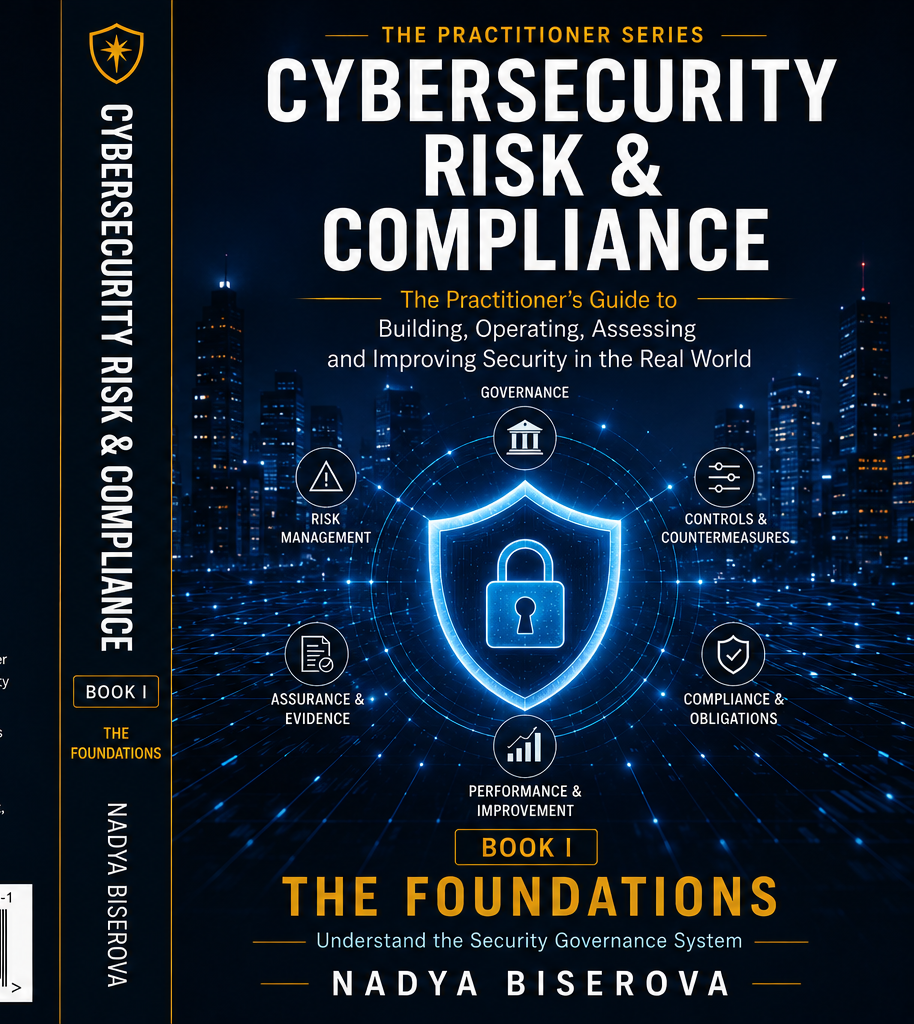
Book I
The Foundations
Understand the security governance system and the relationships between context, risk, authority, controls, evidence, assurance, compliance and improvement.
A practitioner-led professional library about how cybersecurity governance, risk, controls, assurance and compliance actually work together inside real organizations.
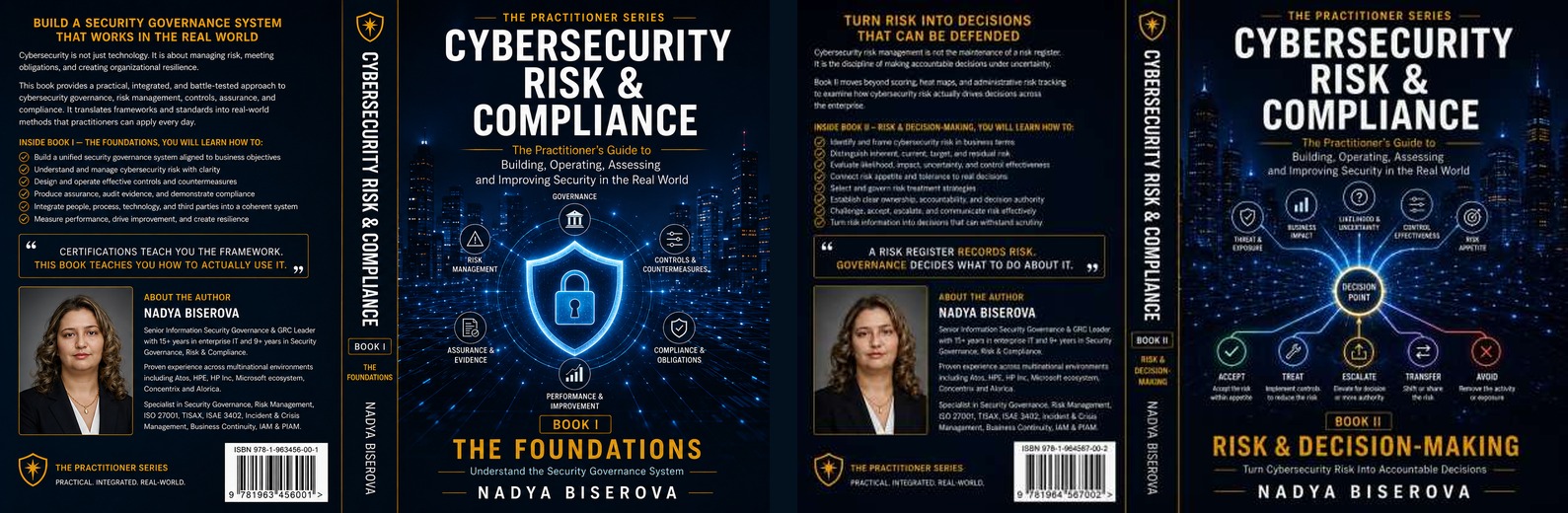
Book I builds the security governance system. Book II turns cybersecurity risk into accountable decisions.
Book I begins with the organization itself: what matters, what creates exposure, who owns risk, who has authority to decide, how governance works, what controls are meant to achieve, what evidence proves, and how assurance and feedback keep the system alive.
Connect objectives, assets, information, services and protection needs.
Move beyond register administration into ownership, appetite, treatment and accountable decisions.
Understand authority, decision rights, escalation, challenge and governance forums.
See controls as mechanisms that must be designed, implemented, operated, tested and improved.
Distinguish evidence of activity from confidence that the intended outcome is actually achieved.
Place external requirements inside the governance system and close the loop through monitoring and feedback.
First Edition · Version 1.0
For practitioners, aspiring GRC professionals, security leaders, auditors, risk professionals and readers who want to understand the system behind the frameworks.
First Edition · Version 1.0 · 364 pages
Cybersecurity risk is not a number. A technical finding is not automatically a business risk. A control existing does not prove that it works. Book II follows risk from the first signal through business context, analysis, controls, residual exposure, appetite, authority, challenge and ultimately the accountable decision.
Ten connected parts move from understanding risk to building a working decision system — then put that system into the practitioner's hands.
Separate technical findings from business risk and frame the decision that actually matters.
Identify exposure, analyze uncertainty and understand business impact.
Test what controls really change and challenge unsupported target residual risk.
Connect exposure to ownership, decision rights and organizational boundaries.
Treat, accept, transfer, avoid or escalate — and make the decision defensible under challenge.
Governance forums, reporting, real-world risk, decision-system design and practitioner application.
The book does not treat governance, risk, compliance, controls and assurance as isolated disciplines. It progressively connects them into one feedback-driven security governance system.
The visual models become more interconnected as the reader progresses, culminating in the complete foundational model in Chapter 11.
Book I establishes the security governance system. Book II takes that foundation into cybersecurity risk and the accountable decisions that follow. Each volume stands on its own while extending one connected practitioner methodology.
Understand the security governance system and the relationships between context, risk, authority, controls, evidence, assurance, compliance and improvement.
Turn cybersecurity risk into accountable decisions — from identification and business impact through controls, residual risk, appetite, authority, challenge and practitioner application.
I remain unavailable to the employment market. I am, however, opening limited availability for defined, outcome-based security governance engagements: a clear problem, a clear scope, a usable result, and a clean handover.
Build or rebuild a security governance environment from the ground up: governance framework, policy architecture, roles and decision rights, risk and exception processes, control requirements, security governance documentation, stakeholder validation and operational handover.
A focused intervention for a defined governance problem: policy framework, risk governance, ISO 27001 / TISAX / assurance readiness, business continuity and resilience governance, supplier security, control governance or another agreed work package.
An independent challenge of an existing security governance model, framework or document set, followed by prioritized findings, decision points and a practical remediation path for management.
Typical deliverables can include policy suites, governance and responsibility models, risk and exception structures, security requirements, audit and assurance readiness, operating-model documentation and final security architecture / governance documentation. Scope is agreed before delivery; engagements are temporary rather than open-ended employment arrangements.
Remote engagements worldwide / Europe. Availability is limited and subject to scope, timing and fit.
nadyabiserova.com is designed to grow into a practitioner knowledge platform — not remain a one-book landing page.
Articles, models, practitioner notes and selected public resources.
Structured lessons, toolkits, scenarios and teaching material derived from the practitioner methodology.
Original creative and AI-assisted media projects, clearly separated from the professional learning catalogue.
English is live first. Russian and German editions are planned as professionally localized releases.

Independent Security Governance & GRC Leader and author of Cybersecurity Risk & Compliance — The Practitioner Series.
Her professional work spans security governance, enterprise risk, ISO 27001, TISAX, ISAE 3402, incident and crisis management, business continuity, IAM/PIAM governance, control assurance, audit readiness and security operating models.
The Practitioner Series turns real-world security governance experience into structured methods practitioners can understand and apply.
Connect on LinkedInNo. It explains the security governance system that sits before, behind and around individual frameworks and certifications.
A protected digital PDF edition licensed for your personal use. After successful payment, Paddle provides your payment confirmation and invoice, while your protected digital edition and its unlock instructions are delivered separately.
Each completed purchase is intended to receive an individually protected copy with a unique, cryptographically generated unlock key. A key is issued for one purchase only and is never reused for another customer.
Legitimate purchasers can request access recovery using their purchase information. The delivery design protects both the author's work and the purchaser's access without relying on intrusive device tracking.
Physical editions are not part of the standard digital storefront. If there is sufficient demand, printed editions can be considered separately with pricing based on production and fulfillment.
Yes. Institutional, educational and multi-copy licensing can be discussed separately from individual digital purchases.
Not yet. English is the canonical first edition. Russian and German localizations are planned and will be released only after full editorial quality review.
No. Individual digital copies are licensed to the purchaser for personal use. Separate arrangements can be discussed for organizational or educational use.
Book I — The Foundations establishes how cybersecurity governance works. Book II — Risk & Decision-Making takes that foundation into the room where exposure must become an accountable decision. Each digital volume is €19.99. Payment, tax calculation and invoicing are handled by Paddle; the protected book copy and unique unlock key are delivered automatically after successful payment.